We have now deployed a working prototype of Piims to manage the pipeline and data for our NSF funded Rice project. This represents a substantial redesign of the Piims system. Some of the major changes are listed below. We are releasing the data as soon as it enters the database. We are in the process of uploading all of the ~7000 samples that we have already run into the database.
New features:
The biggest change is that for Rice, we have incorporated features allowing us to track samples that were grown in fields by collaborators. Piims will now allow us to keep track of Packets of seed that get sent to us.
Piims will track information like field location and weather data for fields.
Piims will now allow for the flexible construction of analysis runs, so packets from different fields and years can be analyzed to together.
Tuesday, March 24, 2009

Thursday, January 8, 2009
New seed grant to develop collaborative tools
We are please to announce that along with our support from NSF and NIH for ionomicsHUB, we have recently been awarded a seed grant from the Purdue University Cyber center to develop collaborative work space and literature sharing tools for the ionomicsHUB. Look out for these new tools in 2009
Monday, October 20, 2008
Sorry for loss of PiiMS service over the last 5-day
Over the last 5-days system administrators have been trying to upgrade the PiiMS system kernel from 32 to 64 bits. We expected that this would increase the performance of PiiMS. Unfortunately, the system administration team ran into some technical problems and was unable to perform the upgrade. We will try again in the near future and would hope to have much less system down time.
Sunday, August 24, 2008
The Figure Reviewers Didn't Like
In our previous attempts to get the Fe model published, we included the figure below. It shows how the Fe model predicts that the Fe status of the soil varied greatly across the many trays that we have run. We like it because it shows that even though the environment is changing (despite our best efforts to keep it constant) this model and others like it will allow us to account for this variation when we look at data.
The reviewers didn't like it for reasons I disagree with so vociferously I shall not repeat them here. So we left it out of the version that was submitted to PNAS.
You can see how changing the soil batch had a major effect on the Fe status of the plants. We were only able to grow plants in Fe sufficient conditions once we started watering with the Fe specific chelator HBED.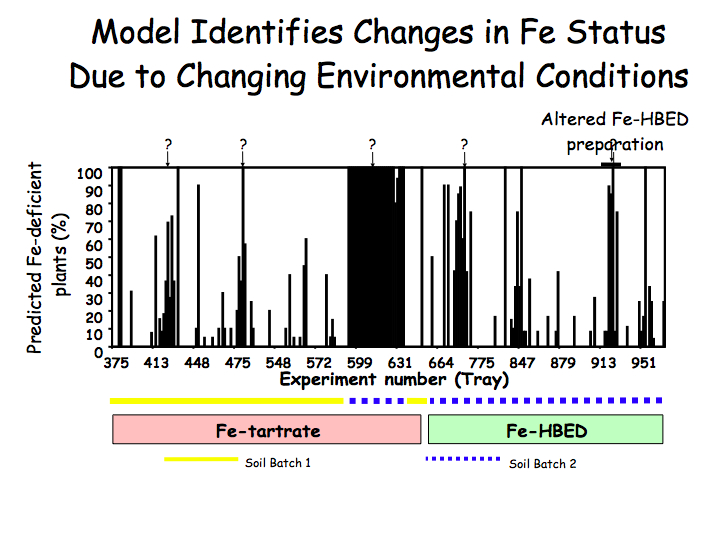
The reviewers didn't like it for reasons I disagree with so vociferously I shall not repeat them here. So we left it out of the version that was submitted to PNAS.
You can see how changing the soil batch had a major effect on the Fe status of the plants. We were only able to grow plants in Fe sufficient conditions once we started watering with the Fe specific chelator HBED.
Wednesday, August 13, 2008
Piims is now all open source.
We have just rolled out the new version of Piims which is based on all open souce software:
the database is Postgres and the front end is run on Tomcat.
We have also added a bunch of functionalities to the lab side of the database and have fixed a large (really large) number of bugs.
Users are now able to see more of the meta-data and pictures of the trays have been visible for awhile now.
The yeast and rice versions of Piims are based on this format and should be publically available soon.
A huge thanks to all the people who worked on this:
Gemez Marshall did the bulk of the work but he had a lot of help from Mourad Ouzzani, Brad Kennedy and Maged Zereba.
the database is Postgres and the front end is run on Tomcat.
We have also added a bunch of functionalities to the lab side of the database and have fixed a large (really large) number of bugs.
Users are now able to see more of the meta-data and pictures of the trays have been visible for awhile now.
The yeast and rice versions of Piims are based on this format and should be publically available soon.
A huge thanks to all the people who worked on this:
Gemez Marshall did the bulk of the work but he had a lot of help from Mourad Ouzzani, Brad Kennedy and Maged Zereba.
Fe&P model paper is online!
Our paper showing how we can use the ionome to detect plants responding to Fe and P deficient conditions is now online at PNAS
Sunday, June 22, 2008
Fe Model is accepted in PNAS
Our paper describing how the ionome can be used to determine the physiological status of a plant has just been accepted for publication in PNAS.
Subscribe to:
Posts (Atom)